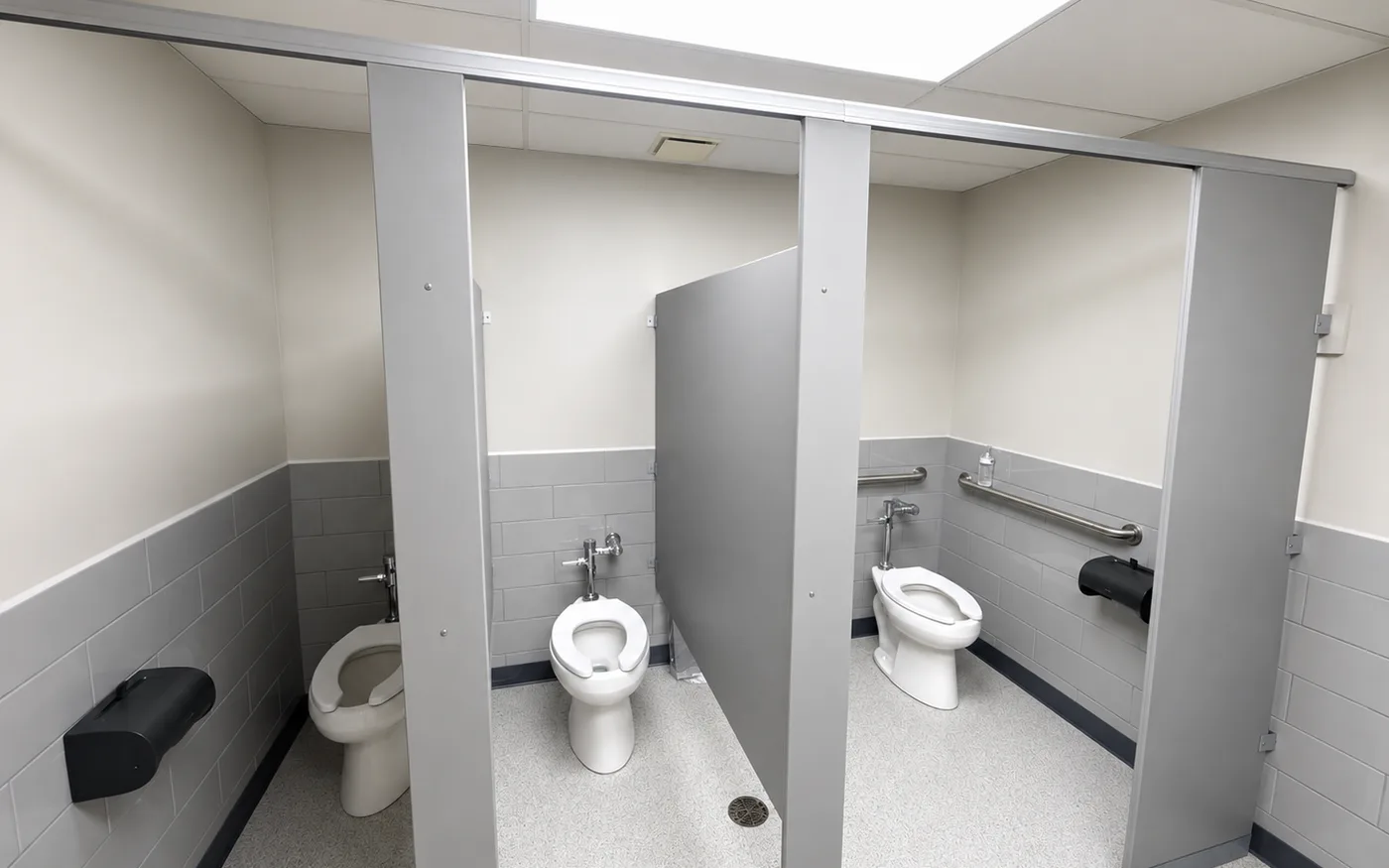
A commercial restroom refresh in DFW runs $8,000 to $12,000 each on i30 Builders' published card: new floor and wall finishes, partitions and accessories, lighting and exhaust, paint and fixture trim, with every fixture left where it is. A full single-user ADA restroom, built out with the plumbing that gets it there, runs $18,000 to $30,000 each. The line between the two is whether anything moves. Moving a fixture, changing the rough-in or changing the layout is the full build, and it is also what tends to bring accessibility requirements into the job.
What does each restroom tier include?
| Tier | Published price | Includes | Excludes |
|---|---|---|---|
| Commercial restroom refresh | $8,000 to $12,000 each | Floor and wall finishes, partitions and accessories, lighting and exhaust, paint, fixture trim | Moving any fixture, plumbing rough-in changes, layout changes that trigger an ADA upgrade |
| Single-user ADA restroom, full build | $18,000 to $30,000 each | Demolition, framing to the compliant clear-floor layout, plumbing rough-in and fixtures, electrical, lighting and exhaust, full finish package, grab bars, accessories and signage | Sewer main work outside the room, water-service upsizing |
Worked: two single-user restrooms built out in full come to $36,000 to $60,000. The same two rooms refreshed in place come to $16,000 to $24,000. The full-build tier is a single-user room. A multi-stall restroom rebuilt in full, with partitions, urinals and several lavatories, has no per-room standard; it is priced on the plan, because the fixture count drives it more than the room does. The tenant improvement cost page carries every published range.
Refresh or full build: what decides it?
- Whether any fixture moves. A refresh replaces finishes around fixtures that stay put; relocating a toilet or lavatory is plumbing rough-in, which is the full build.
- Whether the room already works for a wheelchair user. If the clear floor space, door, grab bars or lavatory height are wrong, fixing them usually means moving something.
- The condition behind the tile. Corroded supply lines, a failing flange or a slow drain found at demolition turn a refresh into rough-in work.
- What the slab allows. Moving a drain on a slab foundation means cutting and patching the slab, and the landlord may restrict where you can do it.
When does a restroom remodel trigger ADA upgrades?
Two rules do most of the work. In Texas they come through both the federal ADA rules and the Texas Accessibility Standards, which follow the same structure.
First, what you alter has to comply. Rebuilding a restroom is an alteration, so each element you replace is built to the current standard: the turning space, the toilet and grab bar layout, the lavatory and its knee clearance, the mirror, the door and its hardware, and the signage. Painting or wallpapering on its own is not an alteration unless it affects usability, but new partitions, fixtures and flooring are altered elements and have to comply.
Second, the path of travel. When you alter a primary function area, where the main business of the space happens, the federal rule requires the route to it and the restrooms that serve it to be made accessible too, unless the cost is disproportionate: more than 20 percent of the cost of the alteration. Where it is, you still spend up to that 20 percent, starting with an accessible entrance, then the route, then at least one accessible restroom for each sex or a single unisex restroom. In Texas, that disproportionality call is made by the Texas Department of Licensing and Regulation rather than by the owner. So an office or retail remodel that never touches the restrooms can still put money into them, which is the most common way a restroom ends up in a project nobody planned it for.
A compliant single-user restroom is mostly a matter of space. Under the Texas Accessibility Standards, which match the federal standards here, it needs a 60 inch turning circle, the toilet centerline 16 to 18 inches from the side wall, a side grab bar at least 42 inches long and a rear one at least 36, and a lavatory no higher than 34 inches with knee clearance under it, plus a compliant door and hardware. Those dimensions are why an old restroom often cannot be fixed in its own footprint, and why the full-build tier exists.
Does a restroom remodel need TDLR registration?
If the project's estimated construction cost is $50,000 or more, a Texas commercial build-out generally has to be registered with the Texas Department of Licensing and Regulation, reviewed by a Registered Accessibility Specialist, and inspected by one after completion. A single restroom refresh will rarely reach that on its own. A remodel that pairs restrooms with a breakroom or office work often does. Registration is separate from the city permit, and it is worth knowing early, because the reviewer looks hardest at exactly the restroom details above. The TDLR registration and RAS inspection guide walks through the process.
Written Scope
Planning this type of project?
Tell us your space, city, and timeline. We return a written scope with lump-sum pricing, no obligation.
Can the restrooms stay open during the work?
Usually one of them can. On our Longview restroom and break room job, an occupied state office building, the two employee restrooms were gutted and rebuilt in sequence rather than at the same time. It cost a few days of duration and meant the staff always had a working restroom on the floor. The work ran after hours, on weekends and on holidays, and the break room was finished in the same mobilization. All three rooms came to $62,000, with scope and price locked in writing before the deposit.
Work sequenced around an occupied building carries a premium, typically 1.2x to 1.4x on the labor portion. The phased renovation page covers how that is planned.
Should the break room be done at the same time?
If it needs it, yes. The plumbing crew, the inspections and the disruption to the tenant happen once instead of twice, and a break room shares the same supply and waste lines more often than not. Pricing for the break room itself is on the breakroom remodel cost page, and the breakroom remodel page shows what that work includes.
Who pays for restroom upgrades in a lease?
Whoever the lease says. Restrooms are among the items a work letter most often leaves vague. Under the federal rule, a tenant's alteration inside its own space does not by itself create path-of-travel obligations for the landlord in areas the landlord controls, so restrooms inside the suite and shared restrooms down the corridor can land on different sides. The guide to who pays for tenant improvements walks through how the work letter decides it.
Restrooms in your next build-out?
Send us the floor plan or walk us through the space. We will tell you whether the restrooms are a refresh or a full build, flag what the path-of-travel rule may pull in, and price it in a written scope. Call (469) 721-0146.
Frequently Asked Questions
Common questions about this topic from DFW tenants, landlords, and business owners.
How much does it cost to remodel a commercial bathroom in DFW?
A refresh with every fixture left in place runs $8,000 to $12,000 each on i30 Builders' published card. A full single-user ADA restroom, including the plumbing rough-in, runs $18,000 to $30,000 each. Multi-stall restrooms rebuilt in full are priced on the plan.
Does replacing restroom finishes trigger ADA upgrades?
Painting alone does not. Anything you replace, such as partitions, fixtures, accessories or flooring, has to meet the current standard. Whether the whole room has to be reworked depends on what else is in the project: altering the main space a restroom serves can pull that restroom into the path-of-travel rule, up to 20 percent of the alteration cost.
Do I need TDLR registration for a restroom remodel?
Only if the project's estimated construction cost reaches $50,000. A single restroom refresh rarely does; restrooms remodeled as part of a larger build-out often do. Registration brings a Registered Accessibility Specialist's plan review and a post-construction inspection.
Can our office keep a working restroom during construction?
Usually, by rebuilding restrooms in sequence rather than together. It adds a few days to the schedule and keeps one restroom open on the floor at all times, which is how the Longview job ran.
What does a refresh leave out?
Moving any fixture, changing the plumbing rough-in, and any layout change that would trigger an ADA upgrade. Those belong to the full build at $18,000 to $30,000 each.
About the author
Yelp
General contractor, Royse City, TX
Commercial tenant improvement, build-out and renovation, and residential outdoor living, fencing, additions and high-end kitchens and baths across Dallas-Fort Worth and East Texas.