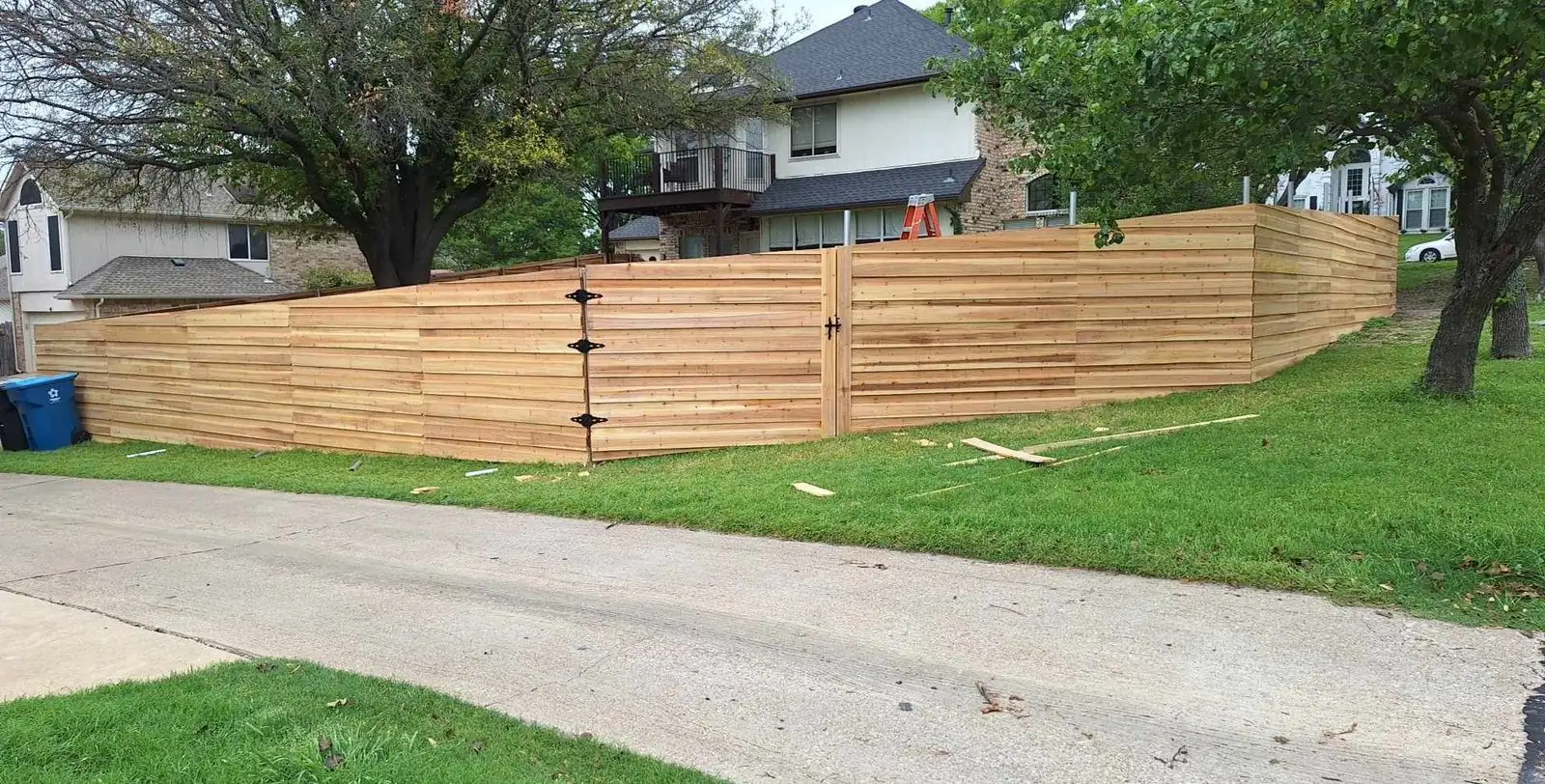
Board-on-board is the privacy fence most North Texas yards get: two overlapping layers of cedar pickets, so gaps stay covered as the wood dries and shrinks. Horizontal is the modern look, with boards running sideways between posts. Side-by-side is one layer of pickets butted edge to edge, the lightest build of the three. On our published rates a 6 ft board-on-board fence is $65/LF and an 8 ft one $76/LF. Horizontal cedar on aluminum posts is $72/LF. Replacing the rails and pickets on sound existing posts is $40/LF.
The style is the part you see. The posts are the part that decides whether it is still straight in year ten, and several cities around here write the post into their code. Both are below.
How do the three styles compare?
| Style | What it looks like | Privacy as the cedar dries | Published price |
|---|---|---|---|
| Board-on-board, 6 ft | Two staggered layers of pickets that overlap | Stays closed: the second layer covers the gaps | $65/LF, $3,500 minimum |
| Board-on-board, 8 ft | The same build at full height | Stays closed | $76/LF, $4,500 minimum |
| Horizontal | Boards running post to post with an even reveal | Set by the reveal you choose between boards | $72/LF, $6,000 minimum |
| Side-by-side | One layer of pickets butted edge to edge | Thin gaps can open as pickets shrink | New fence quoted per project; rails and pickets on sound posts $40/LF |
Why is board-on-board the default here?
Cedar moves with moisture. A picket shrinks across its width as it dries out, so a single layer of pickets that touched on install day can show daylight a season later. Board-on-board answers that by overlapping two layers, so the second row covers the seams of the first no matter how much the wood moves.
Our standard includes demo and haul-off of the existing fence, new posts set in concrete, kickboard, top cap and trim, factory pre-stained cedar pickets, walk gates with locking hardware, cleanup. The 8 ft version is the same scope at full height for $76/LF, and it is worth checking your city's height cap before you pick it. Rockwall, Fate and Royse City all cap privacy fences at eight feet.
Why do we build horizontal fences on aluminum posts?
A horizontal fence shows every post that is out of line, because each board runs straight across them. It also puts the whole span on the posts: a board is only as flat as the distance it has to cover. Our horizontal standard uses powder-coated aluminum posts set in concrete on roughly 6 ft centers, with horizontal cedar boards at an even reveal, an aluminum top cap and trim, corrosion-resistant fasteners and matching walk gates, for $72/LF with a $6,000 minimum.
One thing to check first: a few cities name the post material in their code. Royse City defines a fence post as galvanized steel pipe, Princeton requires schedule 40 steel posts for wood fencing, and Forney requires galvanized steel posts on fences over 52 inches. Read literally, an aluminum post is not a steel post. In those cities we confirm with the city before designing a horizontal fence, and a horizontal fence on steel posts is priced from the walk rather than at the aluminum-post rate.
When does side-by-side make sense?
Side-by-side uses fewer pickets than board-on-board, which makes it the lightest build, and it is what a lot of older fences around here already are. The trade is the gaps: pickets that touched on day one separate as they dry. Where an existing side-by-side fence has sound posts, the cheapest honest fix is new rails and pickets on those posts at $40/LF with a $3,500 minimum. That standard reuses the posts, and any post found unsound once the old pickets come off is priced as a change of work before we touch it. A new side-by-side fence on new posts has no published rate; we quote it from the walk.
What do North Texas cities require of fence posts?
Most cities regulate height and materials and leave the structure to you. These do not. Each rule below is from the city's own code, and the city pages carry the detail and the source.
| City | Post rule in the city's code |
|---|---|
| Royse City | 2-3/8 in galvanized steel pipe, minimum .095 gauge, at least 2 ft deep in concrete, no more than 8 ft apart |
| Fate | Metal posts on all residential fences |
| Princeton | Schedule 40 steel posts for wood fencing, at least 2 ft deep with concrete; wood posts not allowed |
| Forney | Over 52 in: galvanized steel posts at least 2-3/8 in, no more than 8 ft apart, in footings at least 3 ft deep |
| Sachse | Footings at least 24 in deep under 7 ft tall, 36 in at 7 ft and over |
| Heath | Metal or galvanized steel, at least 18 in deep in concrete, no more than 8 ft apart |
| Greenville | Metal posts in pier holes at least 18 in deep and 6 in across |
Even where the code is silent, the ground is not. Much of our service area sits on expansive clay that swells when it is wet and shrinks hard in August, and a shallow post moves with it whatever the pickets are made of. Why posts move, and how they should be set, is in fence posts in North Texas clay.
What else do cities regulate besides the posts?
Written Scope
Planning this type of project?
Tell us your space, city, and timeline. We return a written scope with lump-sum pricing, no obligation.
- Which side faces out. Rockwall puts the cedar pickets on the public side, with posts and framing facing your house. Fate requires the side with exposed posts or rails to face away from the street on lots next to one.
- The material. Rockwall requires solid fencing to be cedar, with pickets at least half an inch thick, and prohibits painting fences.
- Height in both directions. Rockwall sets six feet as the minimum and eight as the maximum for solid fencing. Princeton requires at least a six-foot fence in the side and back yards of most single-family districts.
- The permit. Most cities we work in require one for a new fence, and some for repairs. The fence permit guide covers Rockwall and Royse City in detail.
- Your HOA, which often has its own rules on style, height and stain color and reviews before the city does.
What does a 150-foot run cost in each style?
At the published rates, before any change of work for unsound posts on a rail-and-picket job:
| Style | Rate | 150 ft run |
|---|---|---|
| 6 ft board-on-board cedar fence | $65/LF | $9,750 |
| 8 ft board-on-board cedar fence | $76/LF | $11,400 |
| Horizontal cedar fence, aluminum posts | $72/LF | $10,800 |
| Cedar rail and picket replacement | $40/LF | $6,000 |
On a short run the minimum, not the rate, sets the price: a crew, a truck and a cedar delivery cost the same at 40 feet as at 140. Every standard and what it covers is on the fence cost page.
Cedar or composite?
If you are weighing a composite privacy fence instead of any of these, the trade is a higher price up front against staining you never do. The posts matter exactly as much either way. The cedar vs composite comparison goes through it honestly.
Does the price include stain?
New board-on-board and rail-and-picket work uses factory pre-stained cedar pickets, so the color is in the price. Staining an existing fence so it matches a new section is quoted per run, because how much an older fence soaks up depends on its age and condition. When to restain is covered in the stain guide, which applies to fences as much as decks.
Want a number for your yard?
We walk the line, check the posts and the city rules, and put every style you are considering in a written estimate. See fence installation and repair or call (469) 721-0146.
Frequently Asked Questions
Common questions about this topic from North Texas homeowners.
Which cedar fence style gives the most privacy?
Board-on-board. Its two overlapping layers keep the seams covered as the cedar dries and shrinks, where a single layer of side-by-side pickets can open thin gaps within a season. A horizontal fence is as private as the reveal you choose between boards.
How much does a horizontal cedar fence cost?
Our horizontal standard is $72/LF with a $6,000 minimum, on powder-coated aluminum posts set in concrete at roughly 6 ft centers. A 150 ft run comes to $10,800. Where a city requires steel posts, the fence is priced from the walk instead.
Is board-on-board worth it over side-by-side?
For a privacy fence, usually yes. It uses more pickets, so it costs more to build, but it is the style that stays closed as the wood moves. Side-by-side makes most sense when you are re-picketing an older fence on sound posts.
Do horizontal fences sag?
A horizontal board is only as flat as the span it covers, which is why post spacing matters more on a horizontal fence than on a vertical one. Ours go on aluminum posts at roughly 6 ft centers with an aluminum top cap, so no board spans far, and the posts are set in concrete.
Which side of the fence faces out?
In Rockwall the code decides: the cedar pickets face the public side and the posts and framing face your house. Fate requires the side with exposed posts or rails to face away from the street on lots next to one. Elsewhere, your HOA usually decides, and most want the finished side out.
Can I paint a cedar fence?
Not in Rockwall, which prohibits painting fences. Stain is the usual finish here anyway: a penetrating stain soaks into the cedar rather than sitting on it as a film.
About the author
Yelp
General contractor, Royse City, TX
Commercial tenant improvement, build-out and renovation, and residential outdoor living, fencing, additions and high-end kitchens and baths across Dallas-Fort Worth and East Texas.