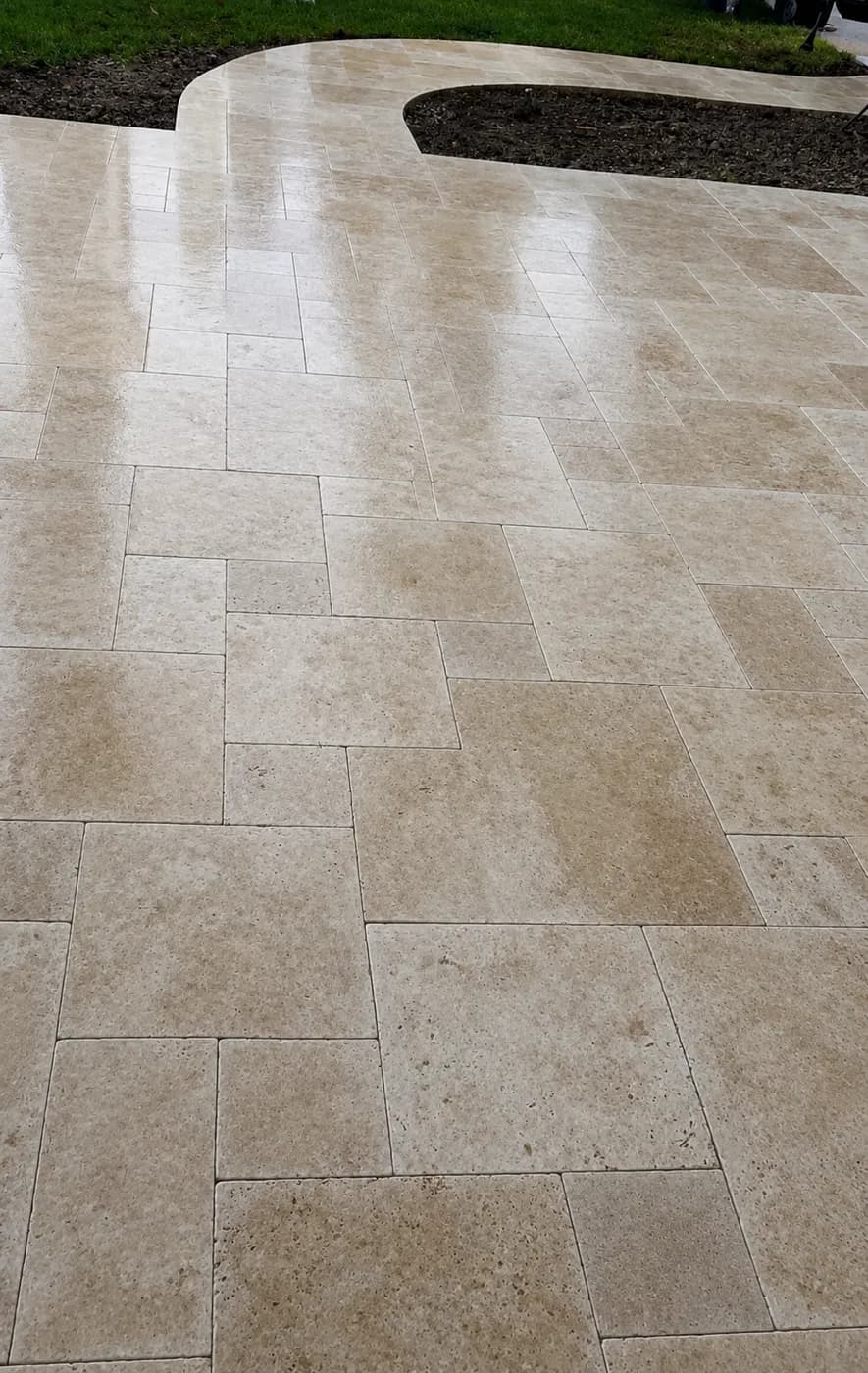
For a North Texas patio, travertine is the coolest underfoot and the easiest to repair when the clay moves, poured concrete needs the least upkeep and has one published rate, and concrete pavers sit between the two in look and feel. On i30 Builders' published prices, reinforced concrete flatwork is $19/SF with a $6,000 minimum, and the last travertine courtyard we built, about 470 square feet in a French pattern plus a matching walkway, was $8,500 all in. Pavers are quoted from the walk. Under all three, the base matters more than the surface you pick.
Which patio surface stays coolest underfoot?
Color does most of the work. A surface that reflects more sunlight absorbs less of it, and the U.S. Environmental Protection Agency's cool pavements guidance is built on that principle: its heat island compendium cites research from the U.S. Department of Energy's Berkeley Lab estimating that every 10 percent increase in solar reflectance can lower a pavement's surface temperature by about 7 degrees Fahrenheit. Light, cream-colored travertine reflects more of an August afternoon than a gray slab or a dark paver. The EPA also notes that new concrete starts out fairly reflective and loses some of that as it ages.
That is why travertine is the usual choice around pools here. Concrete can be poured lighter or left with a broom finish, and pavers come in light colors too, so the gap narrows when you choose the lighter version of each. A dark paver or a stained slab in full sun is the one to avoid if people will walk on it barefoot.
How does each one handle expansive clay?
This is the North Texas question. The clay under most yards here swells when it is wet and shrinks when it is dry, and every patio has to live with that.
- Poured concrete is one rigid slab. When the ground moves, the slab cracks. Steel reinforcement keeps the pieces together and control joints give the cracks a straight line to follow; the National Ready Mixed Concrete Association puts those joints no farther apart than 24 to 36 times the slab thickness, about 8 to 12 feet on a 4 inch patio. The slab itself still cannot flex
- Travertine and concrete pavers are individual units laid over a compacted base with sand in the joints. The paver industry's own association describes pavers as semi-flexible: when a section settles, the units can be lifted, the base adjusted and the same pieces relaid
- Travertine laid dry is only as flat as its base. On soft or poorly compacted ground it rocks and settles at the edges within a couple of summers, which is why base work is most of the risk and most of the price
None of the three is immune. A slab on a well-prepared base with joints cut on a grid holds up for years, and a stone patio on a bad base can be out of level within a couple of summers. The difference is what a repair looks like: a cracked slab is patched or replaced in sections, while a settled stone field is taken up and relaid.
What does each patio surface cost?
| Surface | What we publish | What it covers |
|---|---|---|
| Reinforced concrete | $19/SF, $6,000 minimum | Base preparation, forming, reinforcement, expansion joints, a 4 in pour and a broom finish |
| Travertine, French pattern | $8,500 for one Dallas courtyard of about 470 SF plus a walkway | Re-graded and compacted existing base, concrete edge restraint, steps, polymeric sand and one coat of penetrating sealer |
| Concrete pavers | Quoted from the walk | No paver contract in our books yet, so no published number |
Worked for concrete: a 12 by 20 foot patio is 240 square feet, which comes to less than the minimum at the rate, so it is $6,000. A 20 by 25 foot patio is 500 square feet, $9,500. The concrete cost page works more sizes.
The travertine number is a whole job, not a rate, and it lands closer to concrete than most people expect: about 470 square feet of flatwork at the concrete rate would be $8,930, against $8,500 for the stone courtyard and its walkway. The reason is the base. The courtyard already had a usable gravel base that only needed grading and compaction, which kept it at $8,500. A yard where the base has to be dug out and rebuilt costs more, a smaller patio costs less though not in proportion, and a pool deck costs more per foot because every edge is finished. The travertine cost page shows that job before and after.
What upkeep does each one need?
Written Scope
Planning this type of project?
Tell us your space, city, and timeline. We return a written scope with lump-sum pricing, no obligation.
- Travertine is porous natural stone, and the Natural Stone Institute recommends sealing it for that reason. We seal it once after installation with a penetrating sealer that soaks in rather than sitting on top, so it does not turn slick. It slows staining from leaves, grills and pool chemicals, and resealing every few years is the maintenance. Travertine is a calcium carbonate stone, so acids such as vinegar or citrus juice can etch the surface
- Concrete pavers need their joint sand topped up as it washes out, and an occasional cleaning. Polymeric sand holds better than plain sand
- A broom-finished slab needs the least: an occasional wash. Stamped or stained concrete needs resealing every few years, and a stamped surface can be slicker than a broom finish when wet
Which is best for a pool deck?
Travertine is the common choice for pool decks and coping here, for the reasons above: it stays cooler, a tumbled or honed face keeps its grip when wet, and it can be lifted and reset if a section settles. A pool deck is a different job from a courtyard, though. The coping is set to the pool's bond beam, every edge is finished, and the deck has to shed water away from the pool, so it costs more per foot than a patio. If the pool is salt water, ask which sealer suits it and how often it should be renewed. The travertine pool deck guide covers coping, drainage and sealing in detail.
Do you need a permit for a patio?
Often not, but do not assume it. A patio poured or laid on grade generally needs no building permit in many North Texas cities, and our Dallas travertine courtyard was contracted without one. Some cities do regulate flatwork: Wylie lists extending a driveway or patio among the projects that need a permit, and Sachse permits decks and patios as flatwork. A driveway approach almost always needs one, and anything that touches drainage, a retaining wall or a structure changes the answer. Your HOA may also want to approve the material and color. We confirm the city's rule for your address at the walk.
So which one should you choose?
| If this matters most | Choose | Why |
|---|---|---|
| A firm price before anyone visits | Concrete | One published rate, $19/SF, and the minimum stops mattering once the patio is a few hundred square feet |
| Cool underfoot, barefoot traffic, a pool | Travertine | Light stone reflects more sun, and a tumbled face keeps its grip when wet |
| Repairs without demolition on moving clay | Travertine or pavers | Individual units can be lifted, the base corrected and the same pieces reset |
| Least maintenance | Broom-finished concrete | No joint sand to top up and no stone to reseal |
| A formal, finished look | Travertine in a French pattern | Four stone sizes in a repeating layout hide minor variation in the stone |
| A patio under a new patio cover | Concrete | The slab and the cover footings can be one mobilization |
Want a number on your patio?
We look at the base, measure the area and put a written price on the surface you want. Call (469) 721-0146, or see travertine patios and concrete patios.
Frequently Asked Questions
Common questions about this topic from North Texas homeowners.
Is travertine worth it?
For a patio people walk on barefoot, or a pool deck, usually yes. It stays cooler than a gray slab or a dark paver, keeps its grip when wet, and can be lifted and reset if the clay moves it. Whether it costs more than a broom-finished slab at $19/SF depends on the base: our last courtyard of about 470 square feet plus a walkway was $8,500, because its existing base only needed grading.
Does travertine crack in Texas clay?
On a bad base the stone is usually not what fails first. The field rocks, settles at the edges and opens its joints. Because travertine is laid as separate pieces, a settled section can be taken up, the base fixed and the same stone relaid, which a cracked concrete slab cannot do.
Which is cheapest?
It depends on the base more than the surface. Concrete is $19/SF with a $6,000 minimum, so below about 316 square feet the minimum sets the price. Our one travertine courtyard, about 470 square feet plus a walkway, was $8,500, less than the same area of concrete at the rate, because its existing base only needed grading. A yard that needs its base rebuilt costs more in stone. Pavers are quoted from the walk.
Can travertine go over my old slab?
Sometimes. If the slab is sound, level and drains away from the house, stone can be mortar set over it. If it is cracked, heaved or sits too close to the door threshold, adding stone on top makes the problem permanent. We check the slab at the walk and tell you which it is.
About the author
Yelp
General contractor, Royse City, TX
Commercial tenant improvement, build-out and renovation, and residential outdoor living, fencing, additions and high-end kitchens and baths across Dallas-Fort Worth and East Texas.