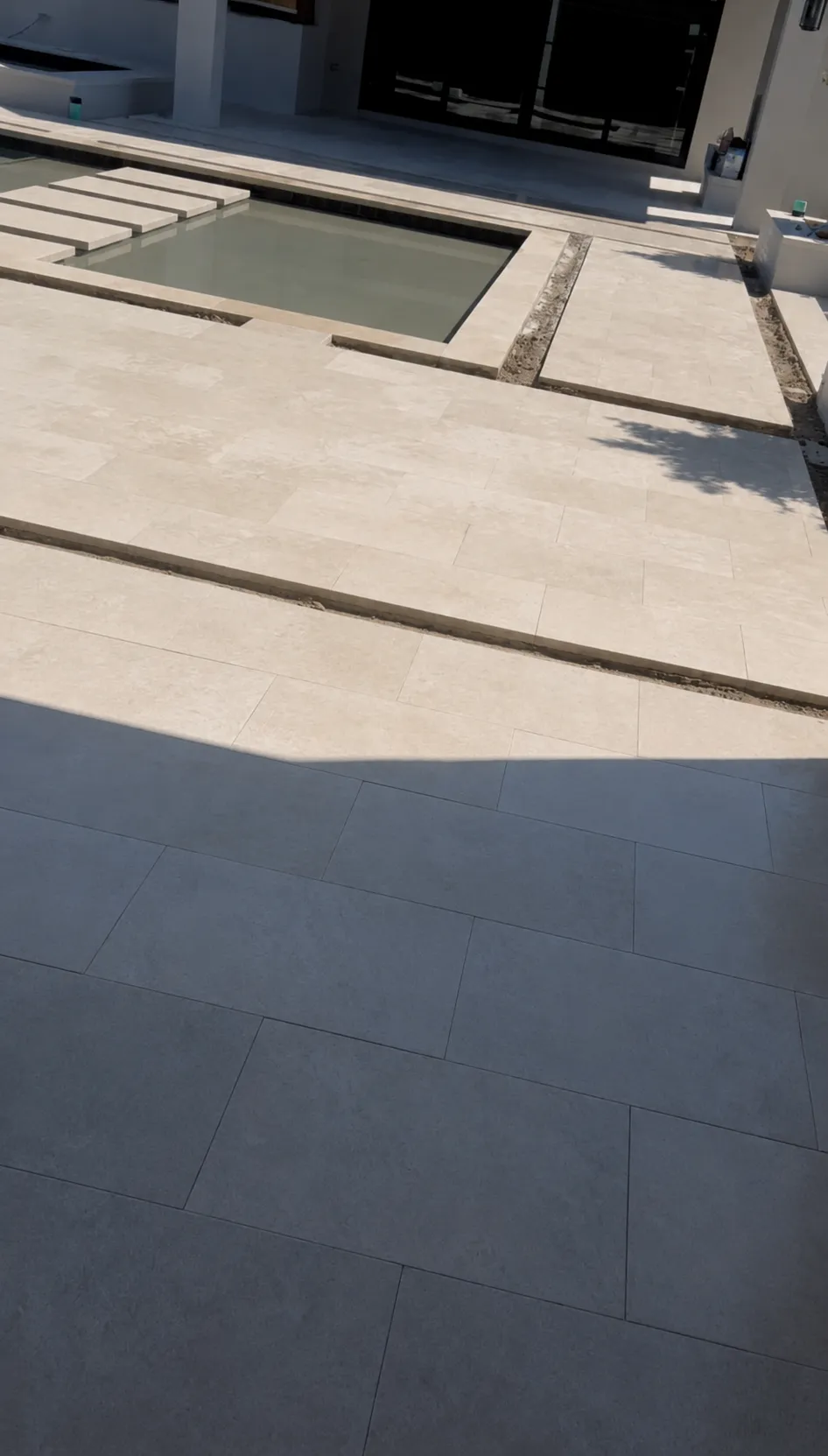
A travertine pool deck costs more per foot than a travertine courtyard, because coping is edge work all the way around the pool and edges are where the labor is. We do not publish a per-square-foot price for it, and we would be wary of anyone who quotes one without seeing the base. The one travertine job in our books is a Dallas courtyard and walkway of about 470 square feet, built for $8,500, and the travertine cost page shows exactly what that bought. A pool deck starts from there and goes up.
What decides whether a stone pool deck lasts in North Texas is not the stone. It is four things under and around it: how the coping meets the pool, which way the water runs, what the deck sits on over our clay, and how the stone is sealed against pool water.
What does a travertine pool deck cost per square foot?
Per-square-foot travertine prices online are averages of jobs nobody can see. The honest version is a list of what has to be in the price, so two quotes can actually be compared. Ask every bidder to say yes or no to each line:
| What to check in a pool deck quote | Why it moves the price |
|---|---|
| Coping included, and which profile | Coping is cut and set piece by piece around the whole pool; a bullnose or rebated edge is more stone and more cutting |
| Removal of the old deck or coping | Demolition and haul-off around a pool is slow, careful work |
| Base: reused, supplemented or rebuilt | The single biggest swing on any stone job, and on clay the most important |
| Set on sand and base, or mortar-set on a slab | Different systems, different labor, different failure modes |
| Drainage: slope, and any deck drains | Water has to leave the deck away from the pool and away from the house |
| Grade and finish of the stone | Regular, premium or select grade; tumbled or brushed rather than polished around water |
| Sealer: type and number of coats | A penetrating sealer is the norm around pools; a color-enhancing one costs more |
| Bonding at the pool perimeter | The electrical bonding around a pool has to be kept intact when the deck is rebuilt |
How does the coping meet the pool?
Coping is the row of stone that caps the pool wall. It is set on the bond beam, the thick concrete beam that runs around the top of the pool shell, in a mortar bed, so it is bonded to the pool rather than resting on the deck. Coping pieces are usually thicker than the field stone or finished with a rounded or rebated front edge, because hands, feet and pool covers all land on that edge.
The pool and the deck move differently. The shell is a rigid concrete structure; the deck around it sits on soil that swells and shrinks. So there is a deliberate expansion joint between the coping and the deck, filled with backer rod and a flexible sealant, never mortar, grout or polymeric sand. The 2021 pool and spa code requires coping joints that protect the coping and its mortar bed for the same reason. A deck locked tight against the coping is how coping gets pushed off the beam.
Which way should a pool deck drain?
Away from the pool. Rain and splash on the deck should run outward, to the lawn, a bed or a deck drain, not back over the coping carrying leaves, dirt and fertilizer into the water. The deck also has to keep water away from the house foundation where the two are close. The 2021 pool and spa code sets the slope for travertine and pavers around a residential pool at a minimum of 1/8 inch per foot and a maximum of 1/2 inch per foot. Getting it right is a matter of grading the base before the first stone goes down, because a finished stone field cannot be re-sloped.
What should a pool deck sit on over North Texas clay?
Travertine pavers are laid over a compacted base, and the base is what keeps the field flat through a wet spring and a dry August on expansive clay. A thin or poorly compacted base under a pool deck shows up as rocking pavers and opening joints within a couple of summers, and around a pool the low spots hold water. The travertine page goes into the base in more detail. On our Dallas courtyard the existing base was sound and only needed grading and compaction, which is why that job came in where it did.
If there is already a concrete deck, stone can sometimes be mortar-set over it. That only works if the slab is sound, level enough, and drains the right way, and if raising the deck surface does not crowd the coping, the doors or the pool equipment. A cracked or heaved slab under new stone makes the problem permanent.
Does travertine work around a saltwater pool?
Written Scope
Planning this type of project?
Tell us your space, city, and timeline. We return a written scope with lump-sum pricing, no obligation.
It can, with sealing and care. Travertine is porous. Pool water that soaks in and dries leaves salt behind in the stone, and salt crystals forming inside the pores can flake the surface over time; sealer makers say travertine around salt water needs extra protection. A penetrating sealer slows water getting in, rinsing splash-out off the deck with fresh water keeps salt from building up, and resealing on the schedule the sealer's manufacturer gives is ordinary maintenance, the same as staining a fence. Tumbled or brushed stone is the right finish around any pool; polished stone is slippery when wet.
Does rebuilding a pool deck involve the electrician?
Often, yes. The National Electrical Code requires the perimeter surface around a permanently installed pool, out to 3 feet beyond the inside walls and including pavers, to be part of the pool's equipotential bonding, tied to the pool's reinforcing steel. That keeps the deck, the water and the metal around them at the same electrical potential. When an old deck comes up, that bonding has to be found, kept intact and reconnected, or replaced, before the new stone goes down. It is a detail that gets skipped when a deck is treated as a patio, and it is one reason a pool deck is not simply a courtyard next to water.
Is travertine cooler underfoot than concrete?
Stone suppliers describe travertine as staying cool underfoot, and a light-colored surface takes in less of the sun than a dark one, which is a large part of why travertine is chosen for pool decks. It is still a stone surface in a Texas August. Shade from a patio cover over part of the deck does more for bare feet than any material.
Do you need a permit for a pool deck?
A stone patio on grade generally does not need a building permit, and our courtyard was built without one. A pool deck can be different: work that touches the pool's electrical bonding, drainage, a retaining wall, or the pool barrier and its gates can bring in the city. Your HOA may have its own review as well. We check your city's rules at the walk.
Redoing the deck around your pool?
We look at the coping, the base and the drainage first, then put the deck in a written scope with every line above answered. See travertine patios and pool decks or call (469) 721-0146.
Frequently Asked Questions
Common questions about this topic from North Texas homeowners.
How much does a travertine pool deck cost per square foot?
We do not publish one, because our only measured travertine job is a courtyard, not a pool deck. That courtyard and walkway, about 470 square feet, was $8,500. A pool deck costs more per foot than that, because the coping around the whole pool is cut and set by hand.
Does travertine work with a saltwater pool?
Yes, with a penetrating sealer, fresh-water rinsing of splash-out, and resealing on the sealer manufacturer's schedule. Travertine is porous, and salt left to dry in the stone can flake the surface over time.
Can travertine go over my existing pool deck?
Sometimes. If the concrete is sound, drains away from the pool and leaves room for the added height at the coping and the doors, stone can be mortar-set over it. A cracked or heaved deck has to come out first.
What is the difference between coping and pavers?
Coping caps the pool wall and is set in mortar on the pool's bond beam. Pavers make up the deck around it, laid over a compacted base. A flexible joint between the two lets the deck move without pushing on the coping.
Is travertine slippery around a pool?
Not in a tumbled or brushed finish, which is what belongs around water. Polished stone is slippery when wet and has no place on a pool deck. A penetrating sealer does not leave a film on the surface.
Do I need to seal a travertine pool deck?
Yes. We seal it after installation, and resealing every few years is maintenance. Around a pool, and especially a saltwater pool, it is the main defense against water and salt getting into the stone.
About the author
Yelp
General contractor, Royse City, TX
Commercial tenant improvement, build-out and renovation, and residential outdoor living, fencing, additions and high-end kitchens and baths across Dallas-Fort Worth and East Texas.