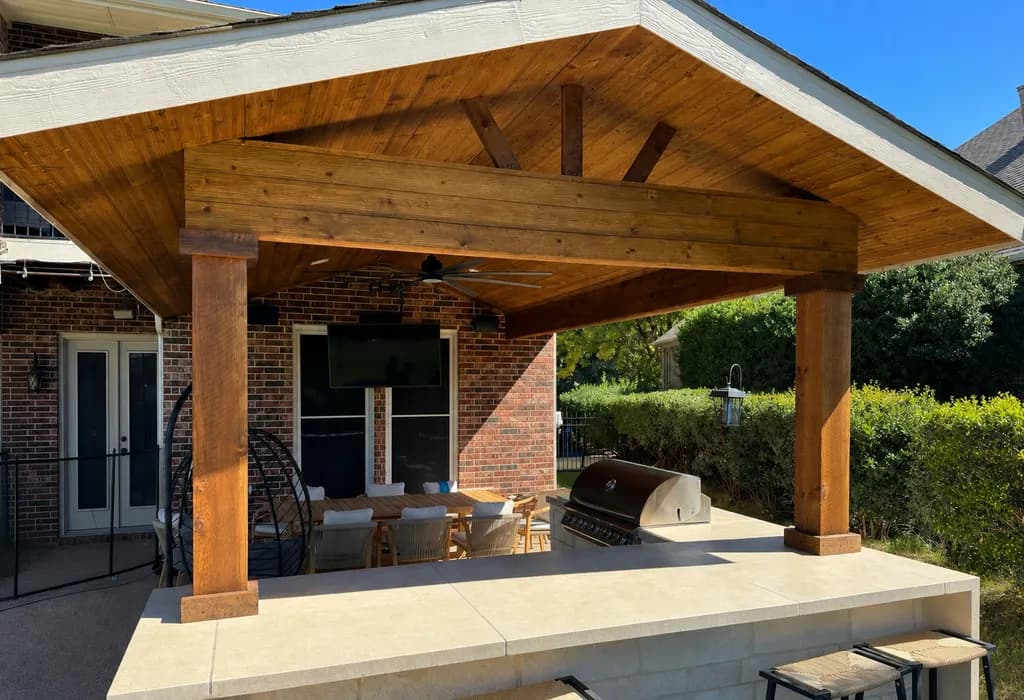
Plan an outdoor kitchen from the utilities out, not from the grill in. Where the kitchen sits decides how far gas, power and water have to travel, and those runs are licensed, permitted trades that set more of the price than the length of the island. Settle six things in this order: placement and smoke, the gas line, power, water and freeze protection, a countertop that survives the sun, and the cover over it.
We quote outdoor kitchens from a site walk rather than a rate, because two islands of the same length can be very different jobs. The roof over one is the exception: our engineered cedar cover is $119/SF plus $2,200 for design, engineering and permits, with rates on the patio cover cost page.
Where should an outdoor kitchen go?
- Near the back door, because food and dishes travel between the two kitchens all evening.
- Away from doors, windows and the neighbor's patio, wherever the smoke tends to drift on a summer evening in your yard.
- As close to the gas meter and the electrical panel as the layout allows. Every foot between them and the island is trench, pipe and wire.
- Out of the late-afternoon sun, or under a roof. A west-facing island in July is a kitchen nobody uses before dark.
- On a base that can carry it. A masonry island is heavy; it belongs on a slab or a footing, not on pavers set over sand.
- Clear of easements and setbacks, and inside whatever your HOA allows. Both are checked before the layout is final.
If there is no slab where the kitchen should go, reinforced concrete flatwork is $19/SF with a $6,000 minimum on our published rates. Pouring the pad and the patio in the same visit is cheaper than coming back for it.
How does the gas line get to the grill?
A natural gas grill is fed from the house supply, so the line runs from the meter or an existing branch, underground, to a shutoff at the island. Texas law counts gas piping as plumbing, so it is work for a licensed plumber, and the cities we build in require a permit for it and inspect it, including a pressure test before the trench is closed. The line is sized for everything it will feed: the grill, side burners and a pizza oven add up, and an undersized line starves the burners when they all run at once. Propane avoids the trench but puts a tank on your patio that has to be refilled and placed to the manufacturer's clearances.
What power does an outdoor kitchen need?
Outdoor receptacles at a house need ground-fault (GFCI) protection under the National Electrical Code, and in a wet location they need weather-resistant receptacles under listed extra-duty covers that stay closed with a plug in them. A refrigerator, ice maker or beverage cooler wants its own circuit, and lighting is cheapest to add while the trench is open. Our exterior electrical standard is a dedicated GFCI-protected circuit from the panel, trenched and in conduit, to two weather-rated outlets, for $1,450. Anything beyond two outlets is quoted on the plan.
Does an outdoor sink need freeze protection?
A sink brings a water supply and a drain, and the drain has to go somewhere the plumbing code accepts, which we settle at the walk rather than in the drawing. The supply is the part North Texas winters find. Pipes in an island are outdoors in everything but name, and a hard freeze like February 2021 splits a full line. Plan a shutoff valve you can reach from inside or from a protected spot, and a way to drain the line down before a freeze. A kitchen without a sink avoids the question, and it is a fair trade for a lot of yards.
Which countertops hold up in Texas sun?
- Granite is natural stone, takes full sun and heat, and is the dependable default. It is sealed after installation.
- Quartz is engineered with resin, and most quartz is sold for indoor use; read the manufacturer's warranty for outdoor terms before you choose it.
- Ultra-compact surfaces are made for exterior use by some manufacturers, with their own outdoor warranty terms.
- Concrete can be formed to any shape, needs sealing, and can show hairline cracks.
- Tile is the most affordable and the most maintenance, because the grout lines are where grease and weather get in.
Whatever you choose, color matters in July. A dark top in direct sun gets too hot to rest a hand on. A light top, or any top under a roof, is a counter you can actually use.
Can the grill go under a patio cover?
Often, if the cover has the height and the ventilation a grill needs. The grill manufacturer's installation manual sets the clearances to combustible construction, overhead and to the sides, and many built-in grills require an insulating jacket when they sit in an island framed with anything that burns. A cedar ceiling is combustible, so under a cover the answer is usually more height, a vent hood rated for outdoor use, or both. We design the island to the manual for the model you choose, which is why the appliances should be picked before the island is built.
Written Scope
Planning this type of project?
Tell us your space, city, and timeline. We return a written scope with lump-sum pricing, no obligation.
If there is no cover yet, building the kitchen and the cover together means one set of footings, one permit set and one trench for the power. The patio cover page shows what we build and the cost page what it comes to.
What drives the cost of an outdoor kitchen?
Not the length of the countertop, mostly. In rough order of how much they move the number:
- 1.Distance from the house, which lengthens the gas, electrical and water runs
- 2.A sink, which brings a supply, a drain and freeze protection
- 3.Powered appliances, each wanting a circuit: refrigerator, ice maker, warming drawer
- 4.Extra cooking appliances on top of the grill: side burners, a smoker, a pizza oven
- 5.Natural stone counters and stone veneer instead of stucco or concrete
- 6.A new cover over the kitchen, which is its own structure with its own engineering
The cheapest version that still works is a grill island close to the house and the gas meter, without a sink, under a cover that already exists.
Does an outdoor kitchen need a permit?
Usually, because nearly every outdoor kitchen involves gas, electrical or plumbing, and those are permitted trades in every city we build in. The gas line is the part inspectors care about most. Your HOA may also want to review the plans before the city sees them. We file the permits, schedule the inspections in order so nothing is buried before it is inspected, and tell you your city's specifics at the walk.
In what order does it get built?
- 1.Appliances chosen, so every cutout and clearance is designed to a real model
- 2.Site walk and written scope, with every appliance named or carried as owner-supplied
- 3.Permits, then the utility trenches, with rough-in inspections before anything is covered
- 4.The slab or footing, if there is not one already
- 5.The island, then countertops templated from the built island
- 6.Appliances set, final connections and final inspections
Planning one for next spring?
We build outdoor kitchens across Rockwall, Rowlett, Garland, Plano and the east side of DFW. Tell us the appliances, where it sits and whether it is covered, and we will walk it. See outdoor kitchens or call (469) 721-0146.
Frequently Asked Questions
Common questions about this topic from North Texas homeowners.
Do I need a permit for an outdoor kitchen in DFW?
Usually. Running a gas line, adding a circuit or plumbing a sink are permitted work in the cities we build in, and the gas line gets the closest look, including a pressure test. An island with no utilities at all may not need one, but very few outdoor kitchens have none. We file the permit and schedule the inspections.
Can I use quartz countertops outside?
Check the manufacturer's warranty first. Quartz is engineered with resin, most of it is sold for indoor use, and outdoor sun is hard on resin. Granite and ultra-compact surfaces made for exterior use are the safer choices in full Texas sun.
Natural gas or propane?
If the house has natural gas, a line from the house supply means never refilling a tank. Built-in grills are ordered for one fuel or the other, so decide before you buy. Propane skips the trench and the line, which can make sense when the kitchen sits far from the meter, but the tank lives on your patio.
Do outdoor kitchen outlets need GFCI?
Yes. Outdoor receptacles at a house need ground-fault protection, and in a wet location they need weather-resistant receptacles with covers that close over a plugged-in cord. Our exterior circuit standard includes both, for $1,450.
What does an outdoor kitchen cost?
We quote outdoor kitchens from the walk, because the utilities and their distance from the house move the number more than the island does. The roof over one is published: an engineered cedar cover is $119/SF plus $2,200 for design, engineering and permits.
Can you build an outdoor kitchen under my existing patio cover?
Often, if the cover is sound and has the height and ventilation the grill needs. We check both against the grill manufacturer's clearances at the walk, before the island is designed around the cover.
About the author
Yelp
General contractor, Royse City, TX
Commercial tenant improvement, build-out and renovation, and residential outdoor living, fencing, additions and high-end kitchens and baths across Dallas-Fort Worth and East Texas.