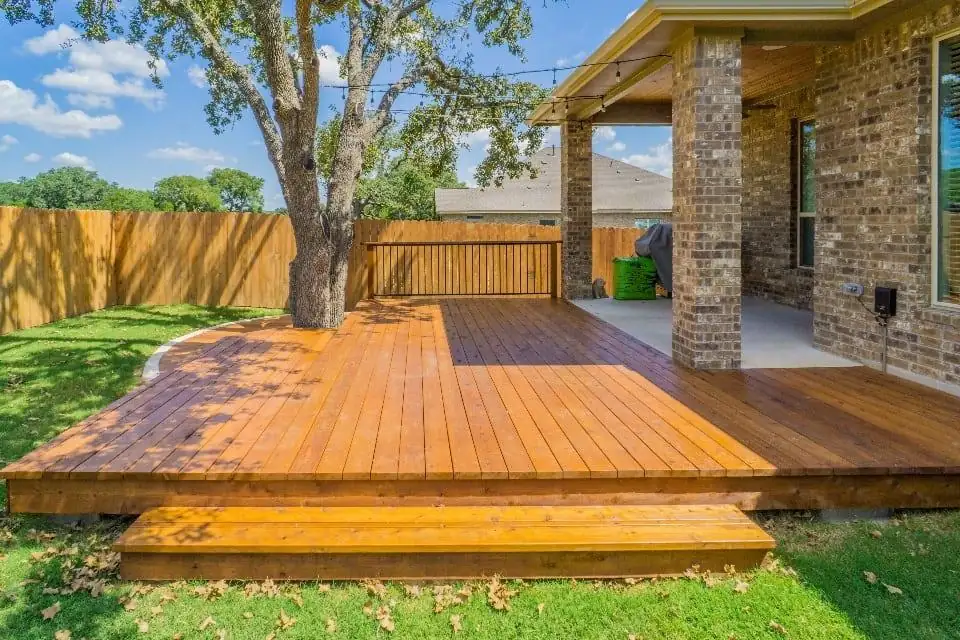
Composite is the low-upkeep choice: no staining, no splinters, boards that resist rot and hold their color, at a higher price up front and with a surface that gets hot in full Texas sun. Cedar costs less, looks like wood because it is, and needs a stain every few years to stay that way. In North Texas the bigger decision is underneath either one: the frame and the footings in expansive clay decide whether a deck stays flat, and they are built the same way whichever board goes on top.
Does composite decking get too hot to walk on?
It can, in full afternoon sun, and the manufacturers say so themselves. Trex's own guidance is that composite, like most outdoor walking surfaces, gets hot in sun and hot weather, that lighter colors stay cooler than darker ones, and that even its heat-mitigating line still gets hot when sun and high temperatures meet (Trex on heat and decking). Cedar warms up too, but it does not hold heat the way a dense composite board does.
- Pick a lighter color if the deck faces south or west with no shade
- Ask for the manufacturer's heat-mitigating line if bare feet are the main use
- Put the deck where a patio cover or a tree can shade it in the afternoon
- If the deck is mostly for evenings, heat matters much less than it sounds
Cedar, pressure-treated pine or composite boards?
| Cedar | Pressure-treated pine | Composite | |
|---|---|---|---|
| Looks like | Wood, warm color, grays without stain | Wood, greener cast, grays and checks | Wood-grain plastic composite, consistent color |
| Upkeep | Clean and stain every few years | Clean and stain, more checking and splitting | Clean it; no staining |
| Heat in full sun | Warm | Warm | Hot, especially darker colors |
| Repairs | Swap a board, stain to blend | Swap a board, stain to blend | Swap a board from the same line if it is still made |
| Up-front cost | Lower | Lowest | Highest |
Pressure-treated pine is what most deck frames are built from, whatever the boards are, and it is used as a decking board when the budget is tight. Cedar is the usual wood board here because it resists rot and takes stain well. Composite costs more for the boards and usually for the hidden fasteners and trim that go with them.
Why does the frame matter more than the boards in clay?
Because North Texas ground moves. Rockwall County, for one, is about 39.5 percent Houston Black clay, which the USDA measures moving roughly 13 percent of its length between wet and dry, with cracks up to four inches wide opening a foot down in a dry summer. A deck footing set shallow in that ground rises and falls with it, and the boards on top, cedar or composite, go out of level with the frame. Footings sized and set deep enough for the ground, a frame built from lumber rated for its exposure, and joists spaced to the board manufacturer's installation guide are what make a deck last. Composite boards in particular often call for tighter joist spacing than wood, which is a frame cost, not a board cost.
If you are re-decking an old frame, the frame gets checked first. New composite boards on a tired frame look new for a season and then show every soft joist underneath.
How much upkeep does each one need?
Cedar: clean it and re-stain on a cycle, more often on boards that take full sun. When to stain a deck in North Texas covers the timing, the moisture test and the signs you are overdue. Composite: wash it, keep debris out of the gaps, and that is most of it. Neither likes standing water or sprinklers hitting the same boards every day.
What do the warranties actually cover?
Written Scope
Planning this type of project?
Tell us your space, city, and timeline. We return a written scope with lump-sum pricing, no obligation.
Composite manufacturers publish warranties on the boards, commonly 25 years or longer on residential lines, and many also cover fading and staining. Read what they exclude: the warranty covers the board, not the frame it sits on, not the footings, and not the labor to install it. Cedar has no board warranty at all; its life is the stain schedule and the frame. Either way, the part of a deck that fails first here is usually underneath it.
Why are decks quoted from the walk?
Because height, not area, is the number. A ground-level deck is a frame and boards. A deck eight feet in the air off a second story is engineered posts, bracing, a ledger detail on the house, stairs and code railings, at the same square footage. We have not published a deck rate because we will not publish one we cannot back with a measured job, so decks are priced from the walk with the height, the access and the board choice in front of us. Deck building and restoration explains what we check.
Do you need a permit for a deck?
Often, and the rule is narrower than people think. Several cities around here build to the International Residential Code, whose model exemption covers a deck only if it is no more than 200 square feet, no more than 30 inches above grade at any point, not attached to the house and not serving the required exit door. An attached deck needs a permit at any height. In Rockwall the deck and patio cover permit is $100 on the city's fee schedule, and lakefront lots inside the Take Line Overlay are capped at decks 24 inches above grade and 1,000 square feet, in composite. Rules differ by city and change, so we confirm yours before we build; the Rockwall page has that city's detail.
Which one should you pick?
| If you | Lean toward |
|---|---|
| Want the lowest up-front cost and do not mind staining | Cedar |
| Never want to stain anything again | Composite |
| Have a south or west deck with no shade and bare feet | Cedar, or a light composite from a heat-mitigating line |
| Are on a Rockwall lakefront lot behind the Take Line | Composite (the overlay requires it) |
| Have a sound frame and tired boards | Either, after the frame is checked |
Get a deck priced from the walk
We check the height, the ground and any existing frame, and price cedar and composite side by side in writing. Covering it later? See patio covers.
Frequently Asked Questions
Common questions about this topic from North Texas homeowners.
Is composite decking worth it in Texas?
If you want to stop staining, usually yes. You pay more up front and accept a hotter surface in full sun; in return the boards resist rot, hold their color and need little more than a wash. If the budget is tight or the deck is mostly in shade, cedar is a good deck too.
Does composite get too hot to walk on?
In full afternoon sun it can, especially darker colors, which the manufacturers acknowledge. Lighter colors and heat-mitigating lines help, and shade helps most.
How long does a cedar deck last here?
It depends far more on the frame, the footings and the stain schedule than on the boards. A cedar deck that is re-stained on time and built on footings set for the clay lasts a long time; one left gray and wet does not.
Can new boards go on my old frame?
Sometimes. We check the joists, the ledger, the posts and the footings first. If the frame is sound and the joist spacing suits the new boards, re-decking is the economical choice.
Do I need a permit for a deck in Rockwall?
Usually. Rockwall's fee schedule lists a $100 permit for decks and patio covers, and lakefront lots inside the Take Line Overlay have their own height and size limits. We confirm the rule for your address and pull the permit.
About the author
Yelp
General contractor, Royse City, TX
Commercial tenant improvement, build-out and renovation, and residential outdoor living, fencing, additions and high-end kitchens and baths across Dallas-Fort Worth and East Texas.