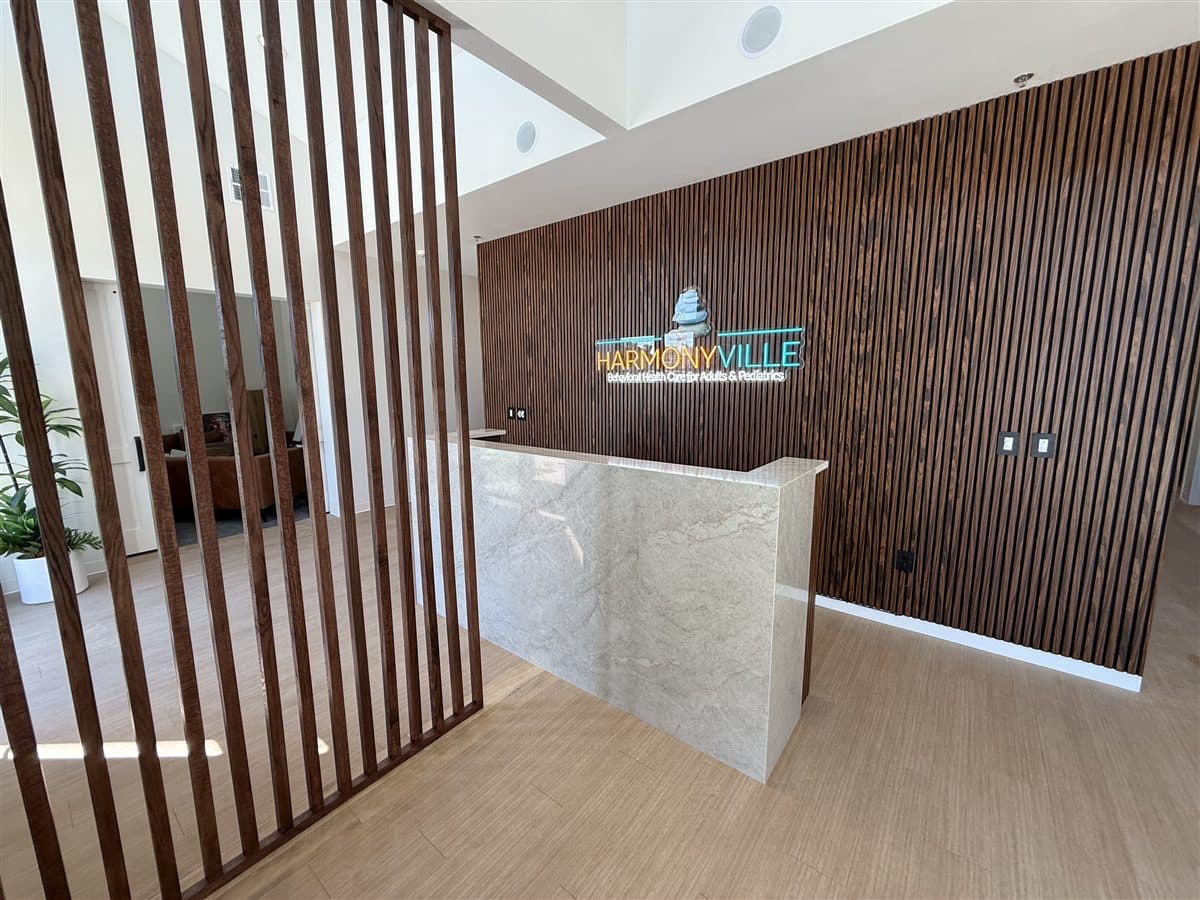
An office reception design-build is a single contract covering both the design detailing and the construction of the first room a client walks into. The scope is:
- The desk
- The feature or brand wall behind it
- The lighting layers
- The flooring and its transitions
- The waiting area
- The power, data, and signage coordination that makes all of it work
Firms buy it as one package rather than as separate design and construction contracts for a simple reason. Reception is the most coordination-dense room in a professional suite relative to its size, and almost everything that goes wrong in it is a handoff failure between parties.
On cost, the honest answer is that square footage predicts very little in a reception scope. A 1,100 square foot office we did in Rowlett with paint, a new twelve-foot partition, a door, trim, and carpet came in at $7,800. A front-of-house and waiting-room rebuild for a McKinney practice ran $38,000. Reception is millwork-dense and finish-dense, so the desk and the wall behind it can carry more of the budget than the entire rest of the room. Price it against a written scope, not a rate card.
Reception Desk Build Cost: What Actually Drives the Number
Four things move a reception desk price: length and geometry, counter material, how much integrated lighting and technology it carries, and the condition of the floor and walls it sits against. A straight run in plastic laminate against a plumb wall is a straightforward shop item. A radius desk with a mitered stone waterfall end, backlit fascia, and six device drops in a suite whose slab is out of level by half an inch is a different job entirely.
| Reception scope band | Published office TI standard | Project minimum | What it typically covers |
|---|---|---|---|
| Reception refresh | $28/SF | $25,000 | Paint, new flooring, updated lighting, refaced or refinished existing desk |
| Light reception build | $65/SF | $25,000 | New laminate or solid-surface desk in an existing lobby, light partition work, new lighting and finishes |
| Standard reception and lobby build-out | $95/SF | $45,000 | New desk, feature wall, layered lighting, flooring with proper transitions, brand signage, waiting area |
| Higher-end client-facing suite | $130/SF | $75,000 | Custom millwork, stone or quartz waterfall counter, glass, integrated and backlit lighting, upgraded acoustics |
Use those bands to set a budget, then let the written scope set the price. Small high-detail rooms consistently price above their band and large simple rooms below it, which is why we quote against an itemized scope rather than a rate. Ask for the desk, feature wall, lighting package, signage coordination, and flooring as separate lines so you can value-engineer the one that is over budget instead of thinning all five.
The Line Items People Forget to Ask About
- Power and data at the desk for workstations, monitors, phone, a visitor sign-in tablet, a printer, the access-control panel, and the door release
- Blocking in the wall for the signage, monitors, and anything mounted behind or above the desk
- Leveling the floor and furring the wall where the existing suite is out of level or out of plumb
- The transaction counter as a distinct element with its own accessibility requirements
- Acoustic treatment, because a hard-finish lobby with a stone counter is a reverberation chamber and check-in conversations carry
- Delivery and installation access, including elevator protection and after-hours windows in a multi-tenant building
Millwork Lead Times Set Your Schedule
On most reception projects the millwork, not the permit, is the longest pole, and each step depends on the one before it. Scope and finishes lock, the shop produces shop drawings, you review and approve them, fabrication begins, and only then does anything ship. Shop drawings typically take one to two weeks and should get a week of genuine review, not a same-day signature. Fabrication commonly runs four to eight weeks after approval, longer for specialty veneers, custom metal, or a held stone slab.
The step that catches people is templating. Stone, quartz, and solid-surface tops are templated from the substructure after it is installed on site, not from the drawings. That makes the desk a two-visit installation: the base goes in, the shop templates it, and the top arrives two to three weeks later. Unplanned, that leaves you with a finished lobby and a plywood counter for most of a month. Practical rule: release the millwork package as soon as the scope is fixed, even if permit review is still running, on any scope where the desk is unaffected by the permit outcome. That decision routinely saves three to four weeks.
ADA Reach Ranges and Clear Floor Space at a Transaction Counter
A reception desk is a sales counter under the accessibility standards, and it is one of the most frequently missed items in professional office suites. The common failure is a raised transaction ledge running the full width of the desk at bar height, with no compliant lower section anywhere along it.
- Parallel approach: a portion of the counter at least 36 inches long with a top no higher than 36 inches above the finished floor
- Forward approach: a portion at least 30 inches long, again no higher than 36 inches, with knee and toe clearance underneath
- Clear floor space of at least 30 by 48 inches positioned for the approach you chose, clear of the door swing and of any furniture
- The accessible section has to be at the place the transaction actually happens, not tucked around a corner where the receptionist cannot see it
- Unobstructed reach range of 15 to 48 inches for anything a visitor operates, including a sign-in tablet, a card reader, or a pen holder
- An accessible route to the counter with 36 inches of clear width and correct maneuvering clearance at the suite entry door
Design the compliant section deliberately and it stops looking like a compliance item. A lowered writing surface at one end reads as a courtesy counter for signing documents, works better for anyone holding a bag or a stack of files, and gives the desk a change in elevation that improves it visually. Solve it in the shop drawings, not in the field, because raising or lowering a fabricated counter after delivery is not a small change.
Reception Lighting Layers
The most common lighting mistake in a professional lobby is a single layer of recessed downlights on the ceiling grid. It lights the floor, leaves the receptionist's face in shadow, flattens the feature wall, and makes the room read as generic. Reception needs four layers doing different jobs.
- Ambient: general illumination sized so the check-in surface is comfortably readable without glare on a monitor
- Task: under-counter or under-shelf lighting at the work surface so the person greeting your clients is lit from the front rather than from directly overhead
- Accent: grazing or wall-wash on the feature wall and any artwork, which is what gives the room depth in photographs and in person
- Brand and decorative: a pendant over the desk, cove or toe-kick lighting in the millwork, or the illumination in the sign itself
Specify a consistent color temperature across every layer and a high color rendering index, because a walnut slat wall and a warm quartz counter read as muddy under a low-CRI cool-white fixture. Put the layers on separate dimmable control zones so the room works at eight in the morning and five in the afternoon. And check the daylight condition: a lobby with a glazed suite entry needs a fixture layer that still holds up at midday.
Slat Feature Walls, Brand Signage, and the Electrical Behind Them
The wall behind the desk does three jobs: it carries the brand, absorbs sound in a hard room, and hides whatever the existing wall looks like. Slat systems are popular because they do all three, but they are only simple if the coordination happens before the wall closes.
Slat Feature Walls
Written Scope
Planning this type of project?
Tell us your space, city, and timeline. We return a written scope with lump-sum pricing, no obligation.
- Confirm the interior finish flame-spread classification for the product in that location; a lobby that also serves as exit access is held to a stricter class than a private office
- Flatten the substrate first, because slats telegraph every hump in an existing wall along their whole length
- Lay the slat pattern out from the sign or the room centerline, never from a corner, or one end will land on a half-width reveal
- Land outlets, switches, and card readers in a slot between slats rather than cutting through one
- Detail the top and bottom terminations deliberately, with a reveal at the ceiling and a base condition that can actually be cleaned
- Specify the acoustic backer if you want the sound benefit; slats over bare gypsum look the part and do very little
Illuminated Signage and Electrical Coordination
Treat the sign as an electrical device with a mounting pattern, because that is what it is. Halo-lit reverse channel letters and backlit acrylic panels need a driver or transformer, a junction box at a specific height and offset, a cavity depth behind the face, and pins or studs that land in blocking rather than in the air between slats. All of that comes from the sign vendor's shop drawings, which means the vendor has to be engaged before rough-in, not after paint.
The sequence that works: select the sign and get its shop drawing with the mounting and power detail, set blocking and the junction box during rough-in, close and finish the wall, then install. Any other order produces a surface-mounted raceway across your new feature wall. Put the sign on the lighting control system or a timer rather than a switch behind the desk. And if the signage is visible from a corridor, atrium, or the exterior, confirm landlord approval and whether a separate sign permit applies, since that review runs on its own clock.
Flooring Transitions in a Lobby
A reception floor usually meets three other conditions: the building corridor at the suite entry, the office carpet behind it, and sometimes a hard surface at the desk. Each junction either disappears or announces itself for the life of the space.
- Put transitions under the closed door leaf or on the door centerline, never out in the open floor where a visitor sees the strip
- Level the substrate rather than absorbing a thickness difference in a bulky transition profile; changes above a quarter inch need a bevel, and larger ones need a ramp
- Order all flooring from one production run so a phased installation does not produce two slightly different dye lots
- Size the walk-off zone at the entry to the traffic it actually receives; a token strip of hard surface inside the door protects nothing
- Check the existing slab for flatness and moisture before committing to a large-format tile or an adhered plank, particularly in an older suite
- Coordinate the transition line with the desk footprint so a seam does not surface in front of the counter where everyone stands
Coordinating a Reception Build Around an Operating Office
Reception is the one room a firm cannot simply close, because it is where clients, couriers, and candidates arrive. The plan has to answer where check-in happens while the desk does not exist, and it has to answer it before demolition, not on the morning of.
In practice that means a temporary greeting station in a conference room or corridor alcove with the phone and access-control functions moved with it, a hard containment barrier with a finished and painted guest-facing side rather than raw studs, and a work window that fits your calendar. Most professional offices are quiet enough after six that evening and weekend phasing works well, and the desk demolition and new base installation usually compress into a single weekend so no client sees the room mid-demolition.
- Keep the suite entry and the egress path clear at every stage, with no exception for a convenient material staging spot
- Protect the building corridor, elevator cab, and elevator lobby; damage to landlord finishes is your liability under most leases
- Confirm freight elevator windows, loading access, and after-hours building access in writing before the schedule is built around them
- Reset the space at the end of every shift so the office opens looking like an office, which is a real nightly cost and belongs in the scope as its own line
- Sequence any noisy work, anchoring, cutting, and coring, into evening windows rather than into a day with client meetings
- Give reception staff a written phase calendar so they can tell arriving clients what is happening and when it ends
We price the phasing premium as a separate line rather than burying it in the rate. Reception scopes are small enough that the honest recommendation is sometimes to clear two consecutive days of client meetings and do the work in daylight, and you can only make that call if you can see what phasing costs.
What to Confirm Before You Sign the Scope
- 1.Whether the desk, feature wall, lighting, signage, and flooring are itemized separately or bundled into one lump line
- 2.Who is responsible for the millwork shop drawings, who approves them, and how long the fabrication and templating windows are
- 3.Where the accessible transaction section is on the drawings and what its height and length are
- 4.Who coordinates the signage vendor, and whether the blocking and junction box locations are in the electrical rough-in scope
- 5.What the lighting control zones and color temperature specification are, since those get value-engineered quietly
- 6.Whether the phasing premium and the nightly reset are their own lines or hidden in the rate
- 7.What happens to the corridor and elevator lobby finishes, and who carries that risk
- 8.Whether the scope triggers a permit at all in your jurisdiction, and who files it
None of those are difficult questions, and a contractor who has actually built client-facing suites will answer all of them in one walk. If any of them draw a shrug, that is the item that becomes a change order in week five.
Free Permit Set & Scope Gap Review
Send us your reception or lobby drawings, or a competing bid, and we will review them free and in writing. We flag the gaps that reliably cost firms money on this scope: a non-compliant transaction counter, missing blocking and power for the sign, millwork lead times nobody scheduled, and phasing folded invisibly into the rate. You keep the review either way. Call (469) 721-0146.
Frequently Asked Questions
Common questions about this topic from DFW tenants, landlords, and business owners.
How much does a reception desk and lobby build cost?
Budget against the published office tenant improvement bands: $28 per square foot for a reception refresh, $95 for a light reception build, $135 for a standard reception and lobby build-out, and $185 for a higher-end client-facing suite with custom millwork and stone. Real projects vary widely because reception is millwork-dense; a small Rowlett office scope of paint, a partition, a door, trim, and carpet ran $7,800, while a McKinney practice's front-of-house and waiting-room rebuild ran $38,000.
What is the lead time on a custom reception desk?
Plan on one to two weeks for shop drawings, a week for genuine review and approval, and four to eight weeks of fabrication after approval, longer for specialty veneers, custom metal, or a held stone slab. Stone, quartz, and solid-surface tops add a templating step: the shop templates the installed base on site and the top arrives two to three weeks after that, which makes the desk a two-visit installation.
Does a reception desk have to be ADA compliant?
Yes. A reception desk is a transaction counter under the accessibility standards. With a parallel approach you need a section at least 36 inches long with a top no higher than 36 inches above the floor; with a forward approach, at least 30 inches long at the same maximum height plus knee and toe clearance. You also need clear floor space of at least 30 by 48 inches at the accessible section, and it has to be where the transaction actually happens.
How should a reception area be lit?
In four layers. Ambient light for general illumination, task light at the check-in surface so the person greeting clients is not backlit or shadowed, accent light grazing the feature wall and artwork, and a brand or decorative layer such as a pendant, cove lighting, or the sign itself. Keep the color temperature consistent, specify a high color rendering index so the finishes read correctly, and put the layers on separate dimmable zones.
What has to happen before an illuminated lobby sign is installed?
The sign vendor's shop drawing has to exist before rough-in, because it carries the mounting pattern, the cavity depth, and the location of the junction box and driver. Blocking and the junction box go in during rough-in, the wall is finished, then the sign is installed. Engaging the sign vendor after drywall is what produces a surface-mounted raceway across a brand-new feature wall.
Do slat feature walls need any special approvals?
Check the interior finish flame-spread classification for the product in that specific location. A reception area that also functions as exit access is held to a stricter class than a private office, and the product data sheet is what the reviewer will want. Beyond code, flatten the substrate first, lay the pattern out from the centerline or the sign rather than from a corner, and specify an acoustic backer if you want the sound benefit rather than just the look.
Can a law or accounting firm stay open during a reception renovation?
Almost always. It requires a temporary greeting station with the phone and access-control functions relocated, a hard containment barrier with a finished guest-facing face, and evening or weekend work windows for anything noisy. The desk demolition and new base installation are usually compressed into a single weekend so clients never see the room mid-demolition, and the space is reset at the end of every shift.
Should reception be designed before the rest of the office scope?
Yes, when the budget allows it to be resolved first. Front-of-house decisions set the finish palette, the lighting specification, and often the power and data layout for the spaces adjacent to it, so resolving reception first prevents a second round of decisions later. It is also the highest-return square footage in a client-facing suite, which makes it the right place to start a phased improvement plan.
About the author
Yelp
i30 Builders Field Leadership
AuthorFounder-Led Field Operations
General contractor, field project management
i30 Builders Editorial Team
Expert ReviewerEditorial and Field Operations
Internal content and field documentation team