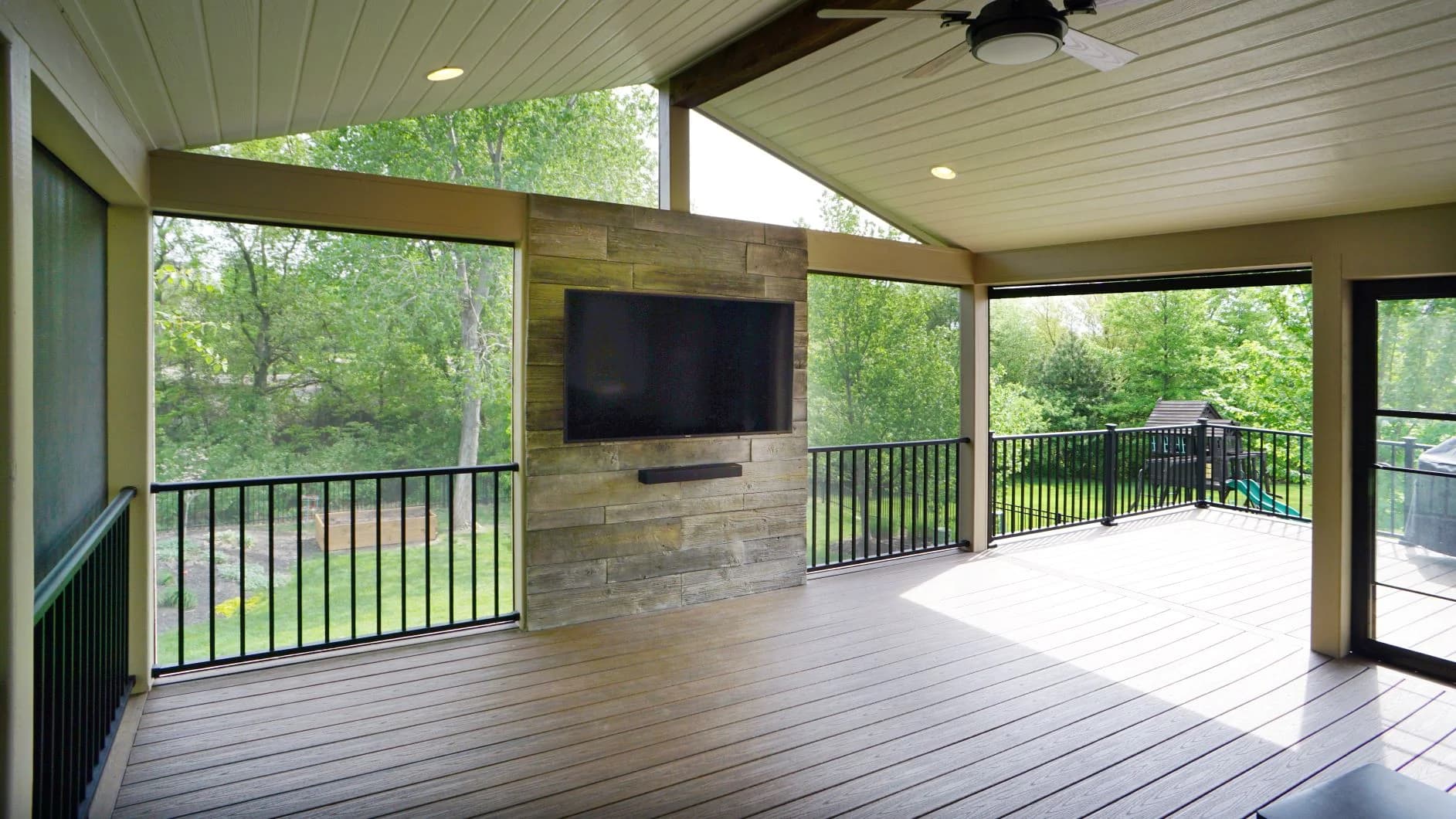
It's one of the most common questions we hear from DFW homeowners: 'Should I do a screened porch or a sunroom?' They look similar from the outside — both add covered outdoor space, both can be year-round additions — but they're fundamentally different projects with different costs, different permit requirements, and different use cases. Here's what we tell our clients.
The Core Difference
A screened porch is an open-air structure with screens replacing solid walls. It's ventilated by nature, protected from insects and debris, and meant to connect you with the outdoor environment without the bugs. A sunroom (also called a four-season room or Florida room) is a fully enclosed structure with glass or polycarbonate walls, its own HVAC connection, and full weatherproofing. It functions like additional interior square footage.
| Screened Porch | Sunroom | |
|---|---|---|
| Cost Range | $15,000–$40,000 | $35,000–$100,000+ |
| Temperature Control | Fans only | Full HVAC |
| Year-Round Use | 9–10 months in DFW | 12 months |
| Permit Complexity | Moderate | High (HVAC, electrical, insulation) |
| HOA Approval | Usually straightforward | Often more restrictive |
| Adds to Square Footage | No | Sometimes |
| Construction Timeline | 3–6 weeks | 8–20 weeks |
Why Screened Porches Make Sense in North Texas
DFW has approximately 230 days per year where outdoor temps fall between 55°F and 90°F — conditions where a screened porch with a ceiling fan is genuinely comfortable. Even in summer, the hours before 11 AM and after 7 PM are often pleasant enough to enjoy a screened space. Mosquitoes and biting flies are a legitimate problem in Hunt and Rockwall counties from April through October, so the screen function is a real quality-of-life improvement.
Screened porches also have simpler permit requirements than sunrooms. They don't require HVAC work, they typically don't require insulation inspections, and they're less likely to trigger HOA height or appearance restrictions. Most HOAs in our service area have straightforward approval processes for screened porches attached to the house, provided they match the existing structure's materials and color.
We build screened porches with composite or wood decking floors, PT or cedar framing, and either aluminum screen frames or EZE-Breeze vertical track windows — a popular option that lets homeowners switch between screened and open-air modes by sliding panels up. Ceiling fans, recessed lighting, and outdoor-rated outlets are standard inclusions on most builds.
When a Sunroom Is the Right Call
If you genuinely want to use the space during July and August afternoons — during the hours when North Texas is legitimately too hot for outdoor comfort — a sunroom is the only option that delivers year-round air-conditioned use. It also works during the occasional North Texas ice storm in January and February.
Free Estimate
Planning this type of project?
Tell us your scope, city, and timeline. We follow up with clear pricing and next steps — no obligation.
Sunrooms cost significantly more because of what's required: a conditioned and insulated foundation or sub-floor, weathertight walls and roofing, low-E glass or polycarbonate panels, electrical panel expansion (sometimes), HVAC extension or dedicated mini-split system, and full waterproofing. The permitting process is much more involved — structural, mechanical, and electrical inspections all apply.
For many DFW homeowners, the sunroom cost ($35,000–$100,000+) versus the screened porch cost ($15,000–$40,000) doesn't match the incremental benefit. A screened porch used 9 months per year is a better return on investment for most families than a sunroom used 12 months per year, especially when the 3 additional months of coverage are the hottest months when many homeowners are inside anyway.
Our Honest Recommendation for DFW Homeowners
For most clients we talk to in Caddo Mills, Rockwall, Royse City, and Heath, a screened porch is the better choice. The cost differential is significant, the usability overlap for DFW's climate is high, and the simpler permitting and HOA process means you're using it sooner. We've built screened porches for clients who specifically said 'I thought I wanted a sunroom until I really ran the numbers.'
The exception: if you work from home and want a quiet glass-enclosed space you can use year-round regardless of weather, or if you have an elderly parent or family member who can't tolerate outdoor temps even with shade and fans, a sunroom may be worth the investment.
Come out and look before you decide
We do free consultations where we look at your space, listen to how you want to use it, and give you honest options — including the one that's right for your budget and your climate. No sales pressure.
Frequently Asked Questions
Common questions about this topic from DFW homeowners and project planners.
Can I use a screened porch year-round in North Texas?
In DFW, you can realistically use a screened porch for 9–10 months per year. Spring and fall are ideal. Summer mornings and evenings are comfortable with a ceiling fan. The only times a screened porch is genuinely unusable are July–August afternoons (heat) and the occasional January freeze. Most of our clients are surprised by how much they actually use their screened porch year-round.
How much does a screened porch cost in DFW?
A standard screened porch attached to an existing home in DFW costs $15,000–$40,000. Most mid-sized builds (250–400 sq ft) with composite or treated wood decking, screen panels, a ceiling fan, and basic lighting run $18,000–$28,000. EZE-Breeze track window systems add $3,000–$8,000 but allow the screens to be replaced with weather panels for cold months.
Does a screened porch add value to a home in Texas?
Yes. Outdoor living space is highly valued in the DFW real estate market. A well-built screened porch typically adds real value at resale, particularly in neighborhoods where competing homes have plain patios or no outdoor living space. We recommend consulting with a local realtor for comparable data in your specific subdivision.
Do I need an HOA approval for a screened porch?
If your neighborhood has an HOA, you'll need ACC (Architectural Control Committee) approval before construction. Most DFW HOAs have relatively straightforward approval processes for screened porches as long as the roofline and materials match the existing house. We submit full design packets on behalf of our clients and work within each HOA's specific requirements.
About the author
Yelp
i30 Builders Editorial Team
AuthorEditorial and Field Operations
Internal content and field documentation team

Karson Lawrence
Expert ReviewerFounder and Project Lead
Licensed Texas contractor, field project manager