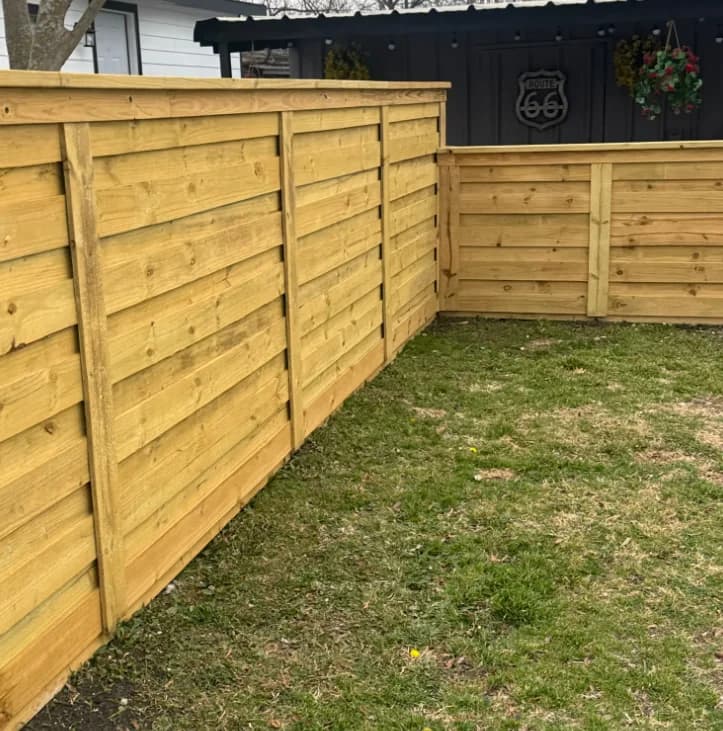
If you've lived in the DFW area for more than five years, you've seen it: fences leaning noticeably off plumb, posts that rock back and forth when you push them, pickets pulling away from rails because the post underneath has shifted. This is not a lumber quality problem. It's almost always a footing depth problem — and it's extremely common in North Texas because contractors are setting posts the same way they would in Houston, Denver, or the Pacific Northwest. In DFW clay, that doesn't work.
The Soil Problem: Expansive Montmorillonite Clay
Hunt, Rockwall, Kaufman, and Collin counties sit on a geological formation dominated by expansive montmorillonite and smectite clay minerals — the same soil type responsible for foundation heave issues in North Texas homes. This clay has a high shrink-swell coefficient, meaning it expands significantly when it absorbs water and contracts sharply when it dries out.
A typical North Texas weather cycle looks like this: spring rains swell the clay dramatically; summer drought shrinks it and creates visible cracks; late-season rains repeat the cycle. Over 3–5 years, each expansion-contraction cycle exerts lateral pressure on fence posts and gradually works them loose — especially when the post is only anchored in the top 24 inches of soil. The moisture and temperature differential between the top 12 inches (which experiences full seasonal cycling) and the deeper stable soil is the key factor.
What Standard Practice Gets Wrong
The common industry standard for fence post depth is one-third of the total post length, or a minimum of 24 inches for a 6-foot fence. In most climates with stable or sandy soil, this is adequate. In North Texas clay, it isn't — because the active soil layer (the zone where significant shrink-swell cycling occurs) extends 24–36 inches below grade in most DFW locations.
A post set 24 inches deep has nearly its entire embedded length in the active shrink-swell zone. Every wet season, the clay pushes sideways against the post and the concrete collar. Every dry season, it pulls away, creating gaps. Eventually, the concrete collar itself can be displaced. The result is a post that has lost its structural integrity within 4–8 years.
The Right Approach: 36–42 Inch Depth in DFW Clay
For a standard 6-foot residential privacy fence, we set posts at a minimum of 36 inches in our primary service area. For posts at corners, gate openings, and hillsides — which experience more lateral load — we go to 42 inches. For 8-foot fence sections, we use 10-foot posts set at 42–48 inches.
At 36 inches, the bottom 12 inches of the post and concrete are in stable soil that doesn't participate in the seasonal shrink-swell cycle. This is the anchor zone that holds the post plumb under lateral pressure from the active clay above. The difference in performance is significant and measurable — we consistently see our fences stay true and plumb 10–15 years after installation in neighborhoods where we know the competitive installations from the same period have already failed.
Post Diameter and Spacing
In North Texas clay, we use 4x4 posts for standard sections and 6x6 posts for corners, gates, and sections over 8 feet. Post spacing should not exceed 8 feet on center for 6-foot privacy fences — many budget contractors push to 10 feet to save posts and concrete, which increases flex in each panel and accelerates picket loosening.
Concrete vs. Foam Post Setting
Free Estimate
Planning this type of project?
Tell us your scope, city, and timeline. We follow up with clear pricing and next steps — no obligation.
Post-setting foam (products like Sika PostFix and Simpson Strong-Tie PostBase) have become popular as a speed solution. Foam sets in minutes versus concrete's 24–48 hour cure time, and manufacturers claim it handles frost heave well in northern climates. Our experience in North Texas clay: we don't recommend foam for primary fence posts in our service area.
The issue is the high lateral soil pressure from expansive clay combined with North Texas summer heat. Foam can compress and deform under sustained lateral load in ways that concrete does not. Concrete, properly mixed and poured, bonds with the post and creates a solid cylinder that resists lateral displacement. The 24-hour wait time is worth it.
Signs Your Fence Was Installed with Inadequate Footings
- —Posts lean noticeably in one direction — typically toward the direction of prevailing spring soil movement
- —You can rock a post back and forth with hand pressure
- —Concrete collar is visible above grade or the collar rocks when you push the post
- —Fence started leaning within 3–5 years of installation
- —Rails have pulled away from posts at the connection point despite intact hardware
- —The fence leans in the same direction as neighboring fences in your subdivision (a sign of a common soil movement pattern)
Questions to Ask Any Fence Contractor in North Texas
- 1.What depth will you set the posts? (You want to hear 36 inches minimum for a 6-foot fence.)
- 2.What diameter post holes will you dig? (Minimum 10-12 inch diameter for adequate concrete surround.)
- 3.What concrete mix will you use? (Sakrete Fast-Setting or 80-pound bags of standard mix — not dry-set foam.)
- 4.How many posts per section? (8-foot spacing maximum for 6-foot privacy fences.)
- 5.Will you use 4x4 or 6x6 posts at corners and gates? (6x6 at corners and wide gates is the right answer.)
A contractor who can answer these questions clearly and specifically is a contractor who has thought about North Texas soil conditions. A contractor who gives vague answers or is clearly unfamiliar with the question probably isn't setting posts correctly.
We show you what we're doing — and why
Our fence estimates include the footing depth, post size, spacing, and concrete method in writing. No guessing about whether your fence was built right.
Frequently Asked Questions
Common questions about this topic from DFW homeowners and project planners.
How deep should fence posts be set in North Texas clay?
In Hunt, Rockwall, and Kaufman county clay, we set 6-foot fence posts to a minimum of 36 inches deep, with corners and gate posts at 42 inches. The standard national practice of 24 inches is insufficient in expansive DFW clay and results in posts that work loose within 4–8 years.
Why is my fence leaning after only a few years?
In North Texas, fence post failure is almost always a footing depth issue. Expansive clay soil exerts significant lateral pressure on posts during wet-dry seasonal cycles. Posts set at standard 24-inch depth are largely in the active soil layer and work loose over time. Inadequate post diameter and excessive post spacing compound the problem.
Can a leaning fence be fixed without replacing the whole thing?
Sometimes. If posts are leaning but rails and pickets are still sound, individual posts can be reset — the old concrete is excavated, the post is pulled, a new deeper hole is dug, and the post is reset with new concrete. This costs $150–$350 per post. If multiple posts have failed throughout the fence, replacement is usually more cost-effective than individual repairs.
Should I use foam or concrete to set fence posts?
For standard fence posts in North Texas clay, we use concrete. Post-setting foam is faster but can compress and deform under sustained lateral load from expansive clay, particularly in summer heat. Properly mixed and poured concrete creates a rigid cylinder that holds its shape under the seasonal soil pressure DFW clay generates.
About the author
Yelp
i30 Builders Editorial Team
AuthorEditorial and Field Operations
Internal content and field documentation team

Karson Lawrence
Expert ReviewerFounder and Project Lead
Licensed Texas contractor, field project manager