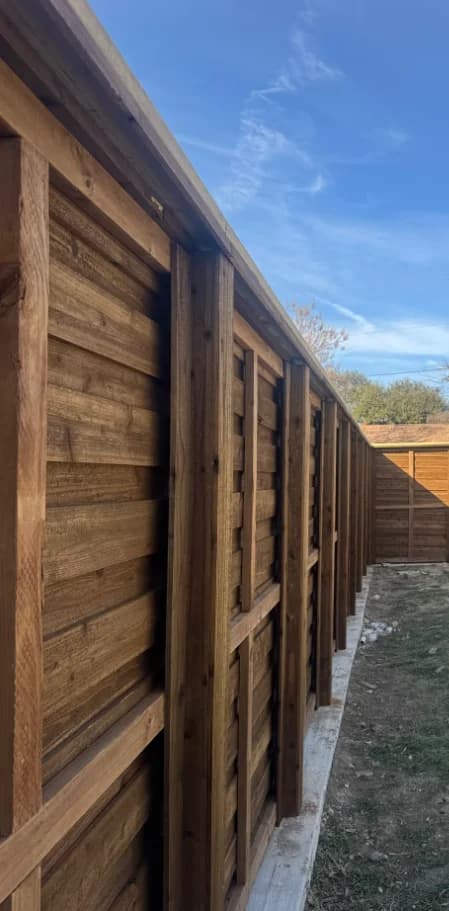
When DFW homeowners call us for a fence estimate, the most common question after 'how much does it cost' is 'should I do cedar or composite?' Both are excellent fencing materials — but they perform differently in North Texas's specific climate and soil conditions, and the right answer depends on how you weigh upfront cost against long-term maintenance. Here's an honest comparison.
Cedar Privacy Fencing in Texas
Western red cedar is the most popular privacy fence material in DFW for a reason: it's naturally rot-resistant, holds up well in Texas heat, and looks beautiful when freshly stained. Cedar contains natural oils (thujaplicin) that act as a preservative, making it significantly more durable than pine without treatment. A well-installed cedar fence with proper post depth and sealed-at-installation pickets typically lasts 15–20 years in North Texas conditions.
The maintenance reality: cedar should be cleaned and re-stained or re-sealed every 3–5 years to maintain both appearance and rot resistance. In North Texas, the combination of intense UV exposure and wet-dry cycling from clay soil means cedar degrades faster than in cooler or more humid climates. Budget $600–$1,500 per staining cycle for a typical 150–200 linear foot backyard fence, depending on whether you DIY or hire out.
Composite Fencing in Texas
Composite fencing uses a blend of wood fiber and PVC or polyethylene — the same general technology as composite decking. It doesn't rot, doesn't warp from moisture cycling, and requires no staining or sealing. Quality composite fence products carry 20–30 year manufacturer warranties. In North Texas's specific conditions — expansive clay, dramatic temperature swings, intense summer UV — composite's dimensional stability is a meaningful advantage over wood.
The tradeoff is upfront cost. Composite fencing runs 50–80% more than cedar for the same linear footage. A 150 linear foot cedar fence in the $5,000–$8,000 range becomes $8,000–$13,000 in composite. The break-even math works out over 10–15 years when you factor in zero maintenance cost, but many homeowners aren't willing to pay the higher upfront price even with the long-term savings.
Side-by-Side Comparison
| Factor | Cedar | Composite |
|---|---|---|
| Upfront cost (150 LF, 6-ft) | $5,000–$8,000 | $8,000–$13,000 |
| Lifespan in North Texas | 15–20 years | 25–35+ years |
| Maintenance required | Stain/seal every 3–5 years | None (occasional cleaning) |
| UV resistance | Moderate (needs sealing) | High (UV-stable resins) |
| Rot resistance | Good (natural cedar oils) | Excellent (no organic content) |
| Appearance | Natural wood grain | Consistent, wood-look or smooth |
| Post system | Typically wood posts | Same aluminum/steel posts |
Free Estimate
Planning this type of project?
Tell us your scope, city, and timeline. We follow up with clear pricing and next steps — no obligation.
The North Texas Variable: Clay Soil and Post Failure
Whether you choose cedar or composite, fence longevity in North Texas depends more on post installation than on the fence panels themselves. Expansive DFW clay exerts significant lateral pressure on fence posts during wet-dry seasonal cycles. Posts set at shallow depth (24 inches is common nationally) work loose within 4–8 years in North Texas clay — regardless of how beautiful the fence panels are above ground.
We set posts at 36–42 inches in our primary service area, with 6x6 posts at corners and gate openings. This is the foundation of a fence that actually lasts. No amount of premium panel material compensates for posts that fail in year 5.
What Our DFW Customers Actually Choose
In our experience, about 70% of our DFW fence clients choose cedar, primarily for the lower upfront cost and natural look. The remaining 30% choose composite — typically homeowners who've had cedar fences fail, who are in higher-end neighborhoods where the curb appeal premium matters, or who are explicitly optimizing for zero maintenance. Aluminum picket fencing is a third option that gets significant interest for pool enclosures and front yards where appearance matters more than privacy.
Free in-person estimates include material samples
We bring cedar and composite samples to every fence consultation so you can compare texture, color, and weight in person before committing.
Frequently Asked Questions
Common questions about this topic from DFW homeowners and project planners.
How long does cedar fencing last in Texas?
A cedar privacy fence with properly set posts (36-42 inch depth in DFW clay), sealed pickets, and periodic re-staining typically lasts 15–20 years in North Texas. The biggest failure mode isn't the cedar itself — it's shallow post installation that allows posts to heave and lean in expansive clay. Cedar pickets that stay dry and sealed can last 25 years; posts set at 18-24 inches in DFW clay often fail in 5–8 years.
Is composite fencing worth the extra cost in Texas?
For homeowners who genuinely dislike maintenance, yes — composite fencing's 50–80% upfront premium pays for itself over 10–15 years when you eliminate 3–5 staining cycles. In North Texas's UV-intense climate, composite's resistance to color fade and dimensional warping is a real advantage. For homeowners who enjoy maintaining their outdoor spaces and value the natural cedar appearance, cedar at a lower upfront cost makes more sense.
What's the most popular fence style in DFW?
Board-on-board cedar privacy fencing is by far the most common residential style in Hunt, Rockwall, and Kaufman counties. Board-on-board (alternating pickets on both sides of the rail) gives the fence a finished appearance from both sides and allows for air circulation that helps the wood dry after rain. Solid-board 'dog-eared' picket fencing is a lower-cost alternative commonly used in older neighborhoods.
Does fencing add value to a home in DFW?
Yes — a privacy fence is one of the most consistent value-adds for Texas homes with children, dogs, or pool areas. A well-maintained cedar or composite privacy fence in good condition is expected in most DFW neighborhoods where competing listings will have them. A missing or failing fence can actually reduce a home's perceived value at sale. New cedar fencing typically returns 50–75% of cost at resale.
About the author
Yelp
i30 Builders Editorial Team
AuthorEditorial and Field Operations
Internal content and field documentation team

Karson Lawrence
Expert ReviewerFounder and Project Lead
Licensed Texas contractor, field project manager